
 Smart Outdoor Lighting
 Intrusion Detection System
 Power Quality Analyzer
 Smart ACMS Solution
 Platform as a Service (PaaS)
 IoT Consultancy
 EazyLIT
 EazyGlow
 EazyProtek
 EazyTalk
 Power Mitra
 Case Studies
 Blogs
Blogs Downloads
How EazyIoT Is Truly Hardware-Agnostic: Simplifying IoT Device Onboarding
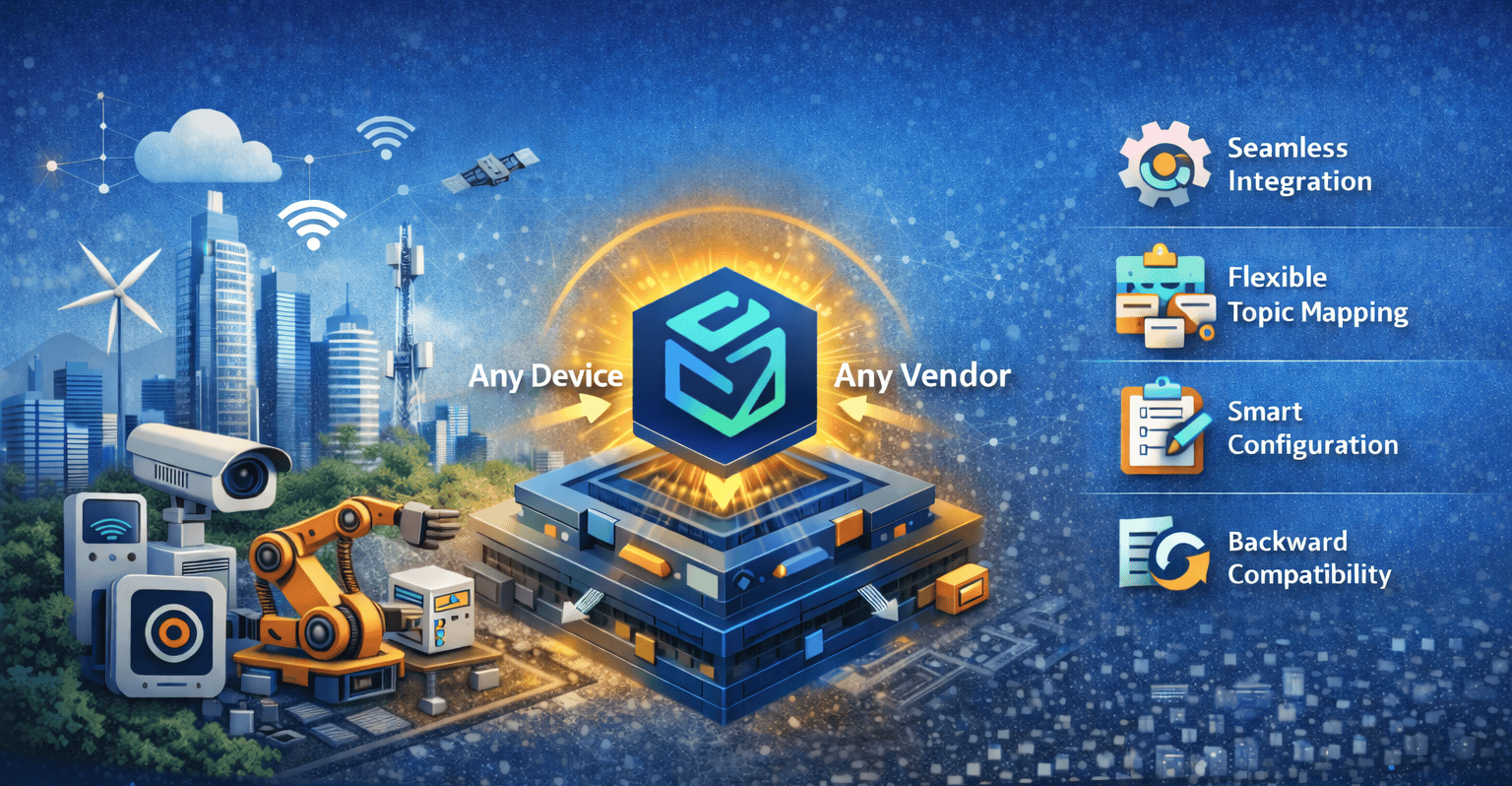
Introduction — Why Hardware Diversity Breaks Most IoT Platforms
Many IoT initiatives fail not because of weak business cases, but because of hardware complexity.
In real-world deployments, organizations rarely operate a single type of device from a single vendor. Instead, IoT environments typically include a mix of legacy hardware, vendor-specific devices, and newer models introduced over time. Each comes with its own communication patterns, capabilities, and constraints.
Most IoT platforms, however, are designed around an idealized device model—uniform protocols, fixed data formats, and predictable behaviour. While this works in controlled pilots, it quickly breaks down as deployments scale. Teams are forced to modify device firmware, introduce custom middleware, or maintain parallel data pipelines just to keep systems running.
This is why hardware agnosticism is a business requirement, not a technical preference.
A truly hardware-agnostic IoT platform allows organizations to onboard diverse devices without re-engineering hardware, avoid vendor lock-in, and scale deployments without accumulating technical debt. EazyIoT was built with this reality in mind.
Why “Hardware-Agnostic” Matters—and Why Most Platforms Get It Wrong
Many platforms describe themselves as hardware-agnostic, but in practice this often means limited multi-device support under strict technical assumptions.
These assumptions typically include native support for MQTT, fixed payload structures, and platform-defined topic hierarchies.
These constraints may remain hidden in early pilots, but they surface quickly at scale. Devices behave differently. Protocols vary. Data semantics are not uniform. Firmware and device capabilities evolve independently of the platform.
When hardware agnosticism is treated as a connectivity feature rather than an architectural principle, platforms become brittle. Integration costs increase, onboarding slows, and operational risk grows.
True hardware agnosticism requires flexibility across protocols, data models, device behaviour, and lifecycle management. EazyIoT addresses these requirements by design.
How EazyIoT Achieves True Hardware Agnosticism
1.Protocol-Agnostic Device Onboarding
Most platforms assume devices communicate using MQTT. In reality, many devices—especially legacy or constrained hardware—use proprietary protocols, TCP/UDP payloads, or custom data formats. EazyIoT removes this dependency through workflow-based protocol abstraction using Node-RED. Incoming data from non-MQTT devices can be parsed, normalized, and internally converted without requiring device firmware changes. Once normalized, the rest of the processing flow remains consistent. This allows devices to be onboarded as they are, significantly reducing integration effort.
2.Flexible Topic Mapping for Constrained Devices
Many IoT platforms enforce fixed MQTT topic structures. However, numerous devices have hard-coded or non-configurable publish topics, making compliance impossible. EazyIoT adapts to device constraints by decoupling device-level topics from the platform’s internal data model. Incoming topics can be mapped and normalized internally, allowing devices to publish using their existing configuration while maintaining platform consistency.
3.Support for Complex, Stateful Device Behaviour
Real-world devices are more than data publishers. They often require configuration updates, command execution, acknowledgements, offline data buffering, and synchronization. EazyIoT treats devices as stateful, interactive entities, enabling bidirectional communication, acknowledgement handling, offline data reconciliation, and device-specific logic without modifying the core platform. This allows nuanced device behaviour to be supported reliably at scale.
4.Separate Modelling of Telemetry and Asynchronous Events
Most platforms store all incoming data as time-series telemetry. This approach fails for critical, asynchronous events such as alarms, faults, or safety notifications. EazyIoT introduces a distinct event model, separate from telemetry. Events are stored, visualized, and processed differently—allowing users to define rules, trigger actions, and generate reports based on event-driven behaviour. Critical signals remain visible and actionable rather than buried in periodic data.
5.Intelligent Device Configuration Models
Many platforms allow only static configuration fields with no validation or contextual logic. This increases the risk of misconfiguration. EazyIoT supports dynamic configuration models with value validation, conditional visibility, role-based access, and contextual enforcement. This ensures configuration accuracy while maintaining flexibility across device types and deployments.
6.Backward Compatibility Across Device Lifecycles
IoT deployments often include devices running different firmware versions simultaneously. Platforms that assume uniform behaviour struggle to maintain stability over time. EazyIoT supports firmware-aware device modeling, allowing older and newer devices to coexist without disruption. Version-specific parsing and logic ensure platform evolution does not force immediate device upgrades.
Operational Resilience and Scalability at Scale
As deployments grow, operational reliability becomes more critical than feature expansion. Device outages, protocol differences, and behavioural inconsistencies can quickly destabilize tightly coupled platforms.
EazyIoT absorbs this variability at the platform layer. Device-specific issues remain isolated, protocol differences do not cascade, and core services continue to operate predictably. New devices, vendors, or use cases can be added without architectural rework.
This enables organizations to scale horizontally across both device count and device diversity while maintaining system stability.
Conclusion — Building Scalable and Resilient IoT Systems
Successful IoT systems are defined by their ability to operate reliably in the face of real-world complexity.
Organizations must support multiple hardware vendors, diverse device capabilities, and nuanced device behaviour—without allowing this complexity to undermine operations. Platforms that assume uniform behaviour struggle as subtle differences in acknowledgements, event patterns, and connectivity become failure points.
EazyIoT is built to handle very nuanced device behaviour by adapting to how devices actually operate. By absorbing complexity at the platform layer, EazyIoT enables scalable, resilient IoT deployments that remain stable as hardware, vendors, and requirements evolve.
If your organization is planning or scaling an IoT deployment and needs to :
- Support multiple hardware vendors without lock-in
- Handle nuanced, real-world device behaviour
- Maintain reliability and control at scale
Explore our Latest Blogs
Dive into expert guides, trends and success stories shaping the future of IoT.

IoT in 2026: What Will Change and How Enterprises Must Prepare
IoT is entering a maturity phase where enterprises must adopt scalable, resilient platforms to ensure long-term success, moving beyond pilots and experiments.
How EazyIoT Is Truly Hardware-Agnostic : Simplifying IoT Device Onboarding
Introduction — Why Hardware Diversity Breaks Most IoT Platforms